Male Breasts: How to Tell Gynecomastia from Chest Fat
Author : Dr. Young-jin SimMarch 30, 2026 at 05:48 PM 1229
Male Breasts:
How to Tell Gynecomastia from Chest Fat
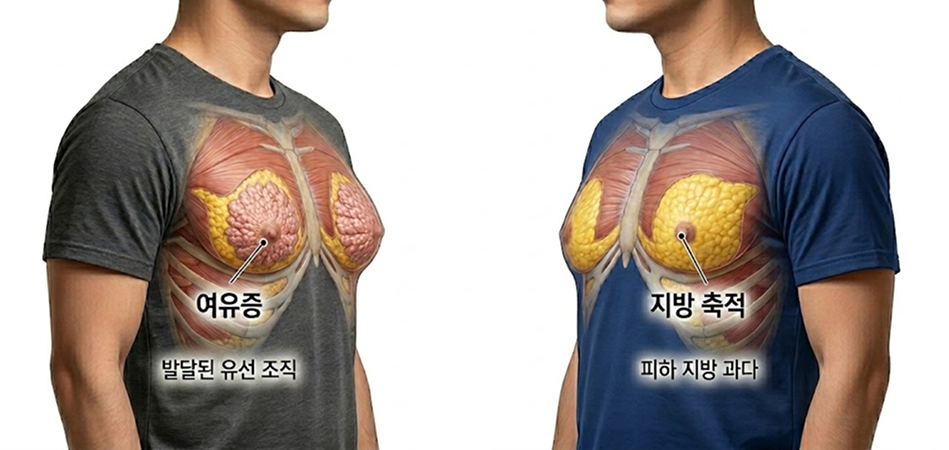
1. Gynecomastia Is a Matter of 'Glandular Tissue.'
2. Chest Fat Is the Result of 'Fat Accumulation.'
| Category | Gynecomastia | Chest fat |
|---|---|---|
| Main cause | Glandular tissue development | Body fat accumulation |
| Palpation findings | Firm tissue beneath the nipple | Generally soft fat |
| Change with weight loss | May show little change | Tends to decrease |
| Tissue composition | Mainly glandular tissue | Mainly fat tissue |
| Treatment | Focused on gland removal | Focused on fat reduction |
Why Does an Accurate Distinction Matter?
3. Treatment Direction Depends on the 'Cause.'
Male Breasts May Be More Than a Body Shape Issue.
Male breasts may stem from differences in tissue composition, not body shape.
An accurate distinction is the starting point of proper treatment.
References
- Gynecomastia review (etiology, mechanism, course) — Braunstein GD. Gynecomastia. N Engl J Med. 2007;357(12):1229–1237. doi:10.1056/NEJMcp070677
- Drug-induced gynecomastia — Bowman JD, et al. Drug-induced gynecomastia. Pharmacotherapy. 2012;32(12):1123–1140. doi:10.1002/phar.1138
Read next — Doctor Column
All Doctor Columns →Customer Story Column
All Customer Story Columns →
Key Background
- · Board Certified Urologist / M.S. in Medicine
- · M.D., Kyungpook National University School of Medicine
View Full Profile ›
"A doctor proven by results and remembered for sincerity — a finish where the detail is different."
"Surgery is a matter of technique, but caring for a patient is always a matter of the heart. I explain not only the result but the process honestly, and think it through together with the patient so they can choose after fully understanding. Through years of male body contouring and men's surgery, one standard has not changed: to take responsibility from before the operation through afterwards, so that the patient does not regret this choice. That, to me, is what medical care is."
- · Residency, Samsung Medical Center, Seoul
- · Fellowship, Gachon University Gil Hospital
- · Member, Korean Society for Sexual Medicine and Andrology (KSSMA)
- · Member, Korean Academy of Aesthetic Medicine
- · Member, Korean Prostate Society (KPS)
- · Member, Korean Association of Breast Surgery (KABS)
- · Member, Union Internationale de Médecine Esthétique (U.I.M.E.)
- · Former Director, Trueman Men's Clinic Gangnam
- · Member, Korean Association of Urogenital Tract Infection and Inflammation (KAUTII) / Korean Society of Urological Infection